
Free Break-Even Calculator
Find the exact units and revenue you need to cover your costs. Enter your fixed costs, variable cost per unit, and selling price to see your break-even point, contribution margin, and the sales needed to hit a profit goal. Built for Shopify sellers. No signup is required.
How to Use the Break-Even Calculator
This break even point calculator needs three numbers. Here is how to use it:
- Enter your fixed costs: These are the costs that stay the same no matter how much you sell, like your Shopify plan, apps, rent, and salaries. A monthly figure works well.
- Enter your variable cost per unit: This is what one extra sale costs you: product cost (COGS), shipping, payment and transaction fees, and pick and pack.
- Enter your selling price per unit: This is what the customer pays for one unit.
- Add a target profit (optional): If you have a profit goal on top of breaking even, enter it. The tool shows the extra units you need to hit it.
- Read your results: The calculator instantly shows the units to break even, the revenue to break even, your contribution margin per unit, and your margin percent.
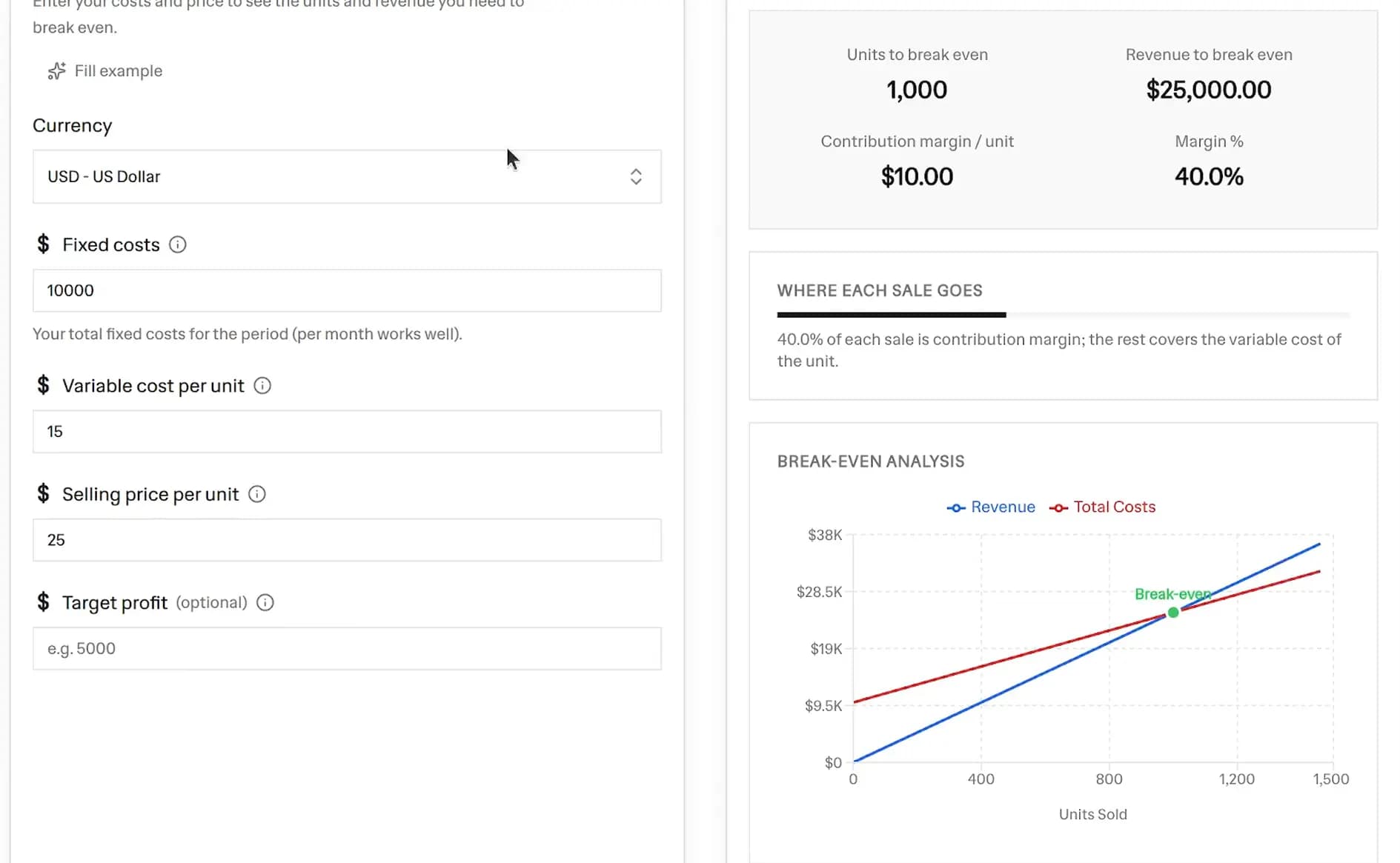 Break-even calculator showing 1,000 units and $25,000.00 revenue to break even from $10,000 fixed costs, $15 variable cost, and $25 selling price, with a $10.00 contribution margin per unit, 40% margin, and a break-even analysis chart where the revenue and total cost lines cross
How to Calculate Break-Even by Hand
You can run a break even analysis with a calculator and three numbers. Follow these steps:
- Find the contribution margin per unit: Subtract the variable cost from the selling price. This is the money each sale leaves over to pay your fixed costs.
- Divide fixed costs by the contribution margin: This gives the number of units you need to sell to break even. Round up, because you cannot break even on a fraction of a sale.
- Multiply units by the selling price: This gives the revenue you need to break even. You can also divide fixed costs by the contribution margin ratio to get the same number.
That is the whole method. The calculator above does this for you and updates as you type.
The Break-Even Formula
The break even formula has two parts: one for units and one for revenue. First, the contribution margin:
Then the break-even point in units:
And the break-even point in revenue:
The contribution margin ratio is just the contribution margin divided by the selling price. In a spreadsheet like Excel, the units formula is =FixedCosts/(Price-VariableCost), so you can build a quick break even calculator excel sheet from the same math.
Worked Example
Say you run a Shopify t-shirt store. Your fixed costs are $10,000 a month. Each shirt costs you $15 in product, shipping, and fees, and you sell it for $25.
First find the contribution margin:
Then divide fixed costs by that margin to get the units:
So you break even at 1,000 shirts, which is $25,000 in revenue, with a contribution margin of $10 per unit, or 40%.
A smaller store with $1,000 in fixed costs, a $10 variable cost, and a $25 price breaks even at just 67 units, because the contribution margin is higher at $15 (60%).
Fixed Costs vs Variable Costs for a Shopify Store
The split between fixed and variable costs is the heart of every break-even analysis. Here is what goes in each bucket for an ecommerce store:
Fixed costs stay the same whether you sell 10 orders or 10,000:
- Your Shopify plan and paid apps
- Rent, warehouse, or storage fees
- Salaries and contractor retainers
- Software subscriptions and accounting tools
Variable costs change with every unit you sell:
- Product cost, also called COGS
- Shipping and fulfilment
- Payment and transaction fees
- Pick, pack, and packaging materials
Break-Even vs Payback Time
Break-even and payback are not the same metric. The break-even point tells you the sales volume where revenue covers costs. The payback period tells you how long it takes to earn back a specific investment, like the cost of new equipment or a marketing push. Use break-even for pricing and feasibility, and use payback when you want to know how many months an investment takes to pay for itself.
Work Backwards: The Most You Can Pay for Inventory
You can rearrange the break even point calculator to solve for your costs instead of your volume. If you know how many units you can realistically sell, you can work out the most you can afford to pay per unit and still break even.
Rearrange the formula so the variable cost is the unknown:
This is a useful sourcing check. If a supplier quote pushes your variable cost above this number at your expected volume, the deal will not break even.
Why Break-Even Matters for Ecommerce
Knowing your break-even point keeps your pricing honest. It tells you the minimum volume a product needs, whether a price is high enough to be feasible, and how much room you have for discounts. It also sets a ceiling on ad spend. Once you know the contribution margin on each order, you can work out your profit margin and your break even ROAS, which is the return on ad spend where ad revenue exactly covers product and ad cost. A store with a 40% margin breaks even on ads at a 2.5x ROAS, so any campaign below that loses money on a per-order basis.
Frequently Asked Questions
What is a break-even point?
The sales level where total revenue equals total costs, so you make zero profit. Below it you lose money; above it you profit.
How do I calculate the break-even point in units?
Divide fixed costs by the contribution margin per unit (selling price minus variable cost). Example: units.
What is the break-even revenue formula?
Fixed costs divided by the contribution margin ratio (contribution margin / selling price). .
What is the difference between fixed and variable costs?
Fixed costs stay the same each month, like your Shopify plan, apps, and rent. Variable costs change per unit sold, like COGS, shipping, and fees.
Is this break-even calculator free?
Yes, it is 100% free, with no signup and unlimited calculations.
How do I find break-even for multiple products?
Estimate your sales mix, work out a blended average contribution margin across your products, then use that single number in the formula.
What is break-even ROAS?
The return on ad spend where ad-driven revenue exactly covers the product cost plus the ad cost. It uses the same contribution-margin idea applied to advertising.
More FREE Store Finance & Documents tools
Price products, forecast ad profit, bill customers, and create invoices, purchase orders, packing slips, and other order documents.
Free Expense Report Template Generator
Build a professional expense report. Add line items, mileage, and a cash advance, pick from 20 templates, and download a print-ready PDF, PNG, or CSV. Free, no signup, no watermark.
Free Timesheet Template Generator
Fill in a weekly, bi-weekly, or monthly timesheet template with live overtime and pay totals, pick from 12 templates, and download a print-ready PDF, PNG, or CSV. Free, no signup, no watermark.
Free Profit Margin Calculator
Calculate your product's selling price, gross margin, and net profit instantly. Factor in shipping and acquisition costs. Free, no signup.
Free Dropshipping Profit Calculator
Enter product cost, markup, ad spend per sale, and shipping to see your selling price, gross margin, and true net profit per dropshipping order. Free, no signup.
Free Print on Demand Profit Calculator
Enter provider base cost, markup, ad spend per sale, and shipping to see your selling price, gross margin, and true net profit per print on demand order. Free, no signup.
Free Markup Calculator
Turn cost and markup into your selling price, gross profit, and margin. Convert markup to margin, see your revenue multiplier, and price in bulk with CSV export. Free, no signup.
Free Etsy Fee Calculator
See every Etsy fee and your exact net payout, then switch to Stripe, Shopify, Square, Depop, Mercari, Poshmark, Reverb, or PayPal. Line-by-line breakdown, profit and margin, and a reverse net-to-price mode. Free, no signup.
Free Stripe Fee Calculator
See Stripe's processing fee and your exact net payout - 2.9% + $0.30 online, 2.7% + $0.05 in person. Line-by-line breakdown, profit and margin, and a reverse net-to-charge mode. Free, no signup.
Free Square Fee Calculator
See Square's processing fee by acceptance method - 2.6% + $0.15 in person, 2.9% + $0.30 online, 3.3% + $0.30 invoice, 3.5% + $0.15 keyed - and your exact net deposit. Profit, margin, and a reverse mode. Free, no signup.
Free Shopify Fee Calculator
See Shopify Payments processing by plan (Basic, Grow, Advanced), the transaction fee a third-party gateway adds, and your exact net payout. Profit, margin, and a reverse mode. Free, no signup.
Free Depop Fee Calculator
See what you keep on a Depop sale under the 2024 US structure - no seller selling fee, just 3.3% + $0.45 processing. Profit, margin, and a reverse net-to-price mode. Free, no signup.
Free Mercari Fee Calculator
See what a Mercari sale leaves you under the 2025 US structure - a flat 10% selling fee on item plus shipping, no seller processing fee. Profit, margin, and a reverse mode. Free, no signup.
Free Poshmark Fee Calculator
See your exact Poshmark earnings with the real US tiered fee - a flat $2.95 under $15, otherwise 20%. Profit, margin, and a reverse net-to-price mode. Free, no signup.
Free Reverb Fee Calculator
See what a Reverb sale leaves you: a 5% selling fee on item plus shipping (capped at $500) plus processing of 3.19% + $0.49 (2.99% + $0.49 Preferred). Profit, margin, and a reverse mode. Free, no signup.
Free Reverse Sales Tax Calculator
Back the sales tax out of any total. Find the price before tax and the tax amount from a gross total, with US state and Canada rate presets. Free, no signup.
Free ROAS Calculator
Calculate return on ad spend, break-even ROAS, and target ROAS, plus the ad budget needed to hit your revenue goal. Free, no signup.
Ecommerce Conversion Rate Calculator
Turn visitors and orders into your conversion rate, see revenue per visitor, and project the extra revenue from hitting a target rate. Free, no signup.
Free Customer Lifetime Value Calculator
Calculate customer lifetime value (CLV) two ways - historic and predictive - see net value after acquisition cost, and get a plain-English CLV:CAC health verdict. Built for Shopify and ecommerce. Free, no signup.
Free Customer Acquisition Cost Calculator
Calculate customer acquisition cost (CAC), compare blended vs paid CAC by channel, and get an LTV:CAC health verdict plus the CAC payback period. Built for Shopify and ecommerce. Free, no signup.
Free Shopify Profit Calculator
Calculate net profit and margin per order after COGS, shipping, ads, returns, and real Shopify plan and payment fees. See break-even CPA and ROAS, a profit waterfall, and the order volume where each Shopify plan becomes the cheapest. Free, no signup.
Free Invoice Generator
Create professional invoices with your logo, line items, tax, and discounts. Live preview and instant PDF download. Free, no signup.
Free Packing Slip Generator
Create a clean packing slip for any order. Add your logo, ship-to address, and items, then download a print-ready PDF. No prices, no signup.
Free Purchase Order Generator
Create a purchase order to send your supplier. Add the vendor, line items with agreed prices, and a delivery date, then download a PDF. Free, no signup.
Free Commercial Invoice Template
Create a customs-ready commercial invoice for international shipping. Add HS codes, country of origin, Incoterms 2020, weights and the declaration, then download a PDF. Free, no signup.
Free Proforma Invoice Template
Create a quote-style proforma invoice you can send before the sale is final. Add a valid-until date, itemised freight, and optional customs fields and Incoterms 2020, then download a PDF. Free, no signup.
Free Credit Memo Template
Create a print-ready credit memo that reduces what a customer owes on a prior invoice. Reference the original invoice, list the credited items, and the tool computes the credit total, then download a PDF. Free, no signup.
Free Bill of Lading Template
Create a print-ready straight bill of lading for domestic LTL freight. Add the shipper, consignee, carrier, freight lines with weight and NMFC class, and freight charge terms, then download a PDF. Free, no signup.
Free Work Order Template
Create a print-ready work order for a service call, preventive maintenance, HVAC, plumbing, construction or auto repair job. Add the service location, equipment, task checklist, labor and parts, then download a PDF with technician and customer sign-off. Free, no signup.
Free Order Form Generator
Create a professional order form template with line items and live totals. Add your logo, customer, and prices, then download a PDF. Free, no signup.
Free Quote Generator
Create a professional price quote with your logo, client details, line items, and a valid-until date. Live preview and instant PDF download. Free, no signup.
Free Estimate Generator
Create a professional job estimate with your logo, client details, line items, and an estimated total. Live preview and instant PDF download. Free, no signup.
Free Packing List Generator
Create an itemized packing list for ecommerce, wholesale, and freight shipments. Add shipper, consignee, and contents, then download a PDF. Free, no signup.
Free Delivery Note Generator
Create a delivery note with a signature line for proof of delivery. Add your details, the deliver-to address, and items, then download a PDF. Free, no signup.
Free Return Form Generator
Create a printable return form or RMA form for ecommerce returns. Add the return-from address, items, and reason, then download a PDF. Free, no signup.
Free Shipping Label Generator
Make a printable shipping label with From / To and package details. Pick a 4x6, half-sheet, or Avery template, add a barcode or QR, bulk-generate from CSV, and download PDF, PNG, or SVG. No email, no signup, no watermark.
Free Shopify Order Bill Splitter
Split a group Shopify order fairly. Import items from a product link, assign who shares what, split shipping, tax, and discounts, and see who pays whom with the fewest payments. Free, no signup.
Free Facebook Ads Calculator
Forecast your Facebook ad profits with real industry benchmarks, interactive sliders, and reverse budgeting. See ROAS, CPA, and net profit instantly. Free, no signup.
Free Instagram Ads Calculator
Forecast your Instagram ad costs and profits with real Instagram benchmarks, interactive sliders, and reverse budgeting. See ROAS, CPA, and net profit instantly. Free, no signup.