
Free Ecommerce Conversion Rate Calculator
Turn visitors and orders into your conversion rate, see your revenue per visitor, and project the extra revenue from hitting a target rate. Built for Shopify and DTC stores. No signup is required.
How to Use the Conversion Rate Calculator
This sales conversion rate calculator needs just two numbers to start. Here is how to use it:
- Enter your visitors: Type the total visitors or sessions for the period you are measuring. Most ecommerce teams use sessions.
- Enter your conversions: Type the number of orders (or goal completions) in that same period.
- Read your conversion rate: The tool instantly shows your rate as a percent and as a decimal, with a benchmark verdict for ecommerce.
- Add average order value (optional): This unlocks your revenue and your revenue per visitor.
- Add a target conversion rate (optional): This shows the orders and the extra revenue you would earn at that rate from the same traffic.
- Break down your funnel (optional): Open the funnel section to enter your four stage rates and find the leakiest step to fix first.
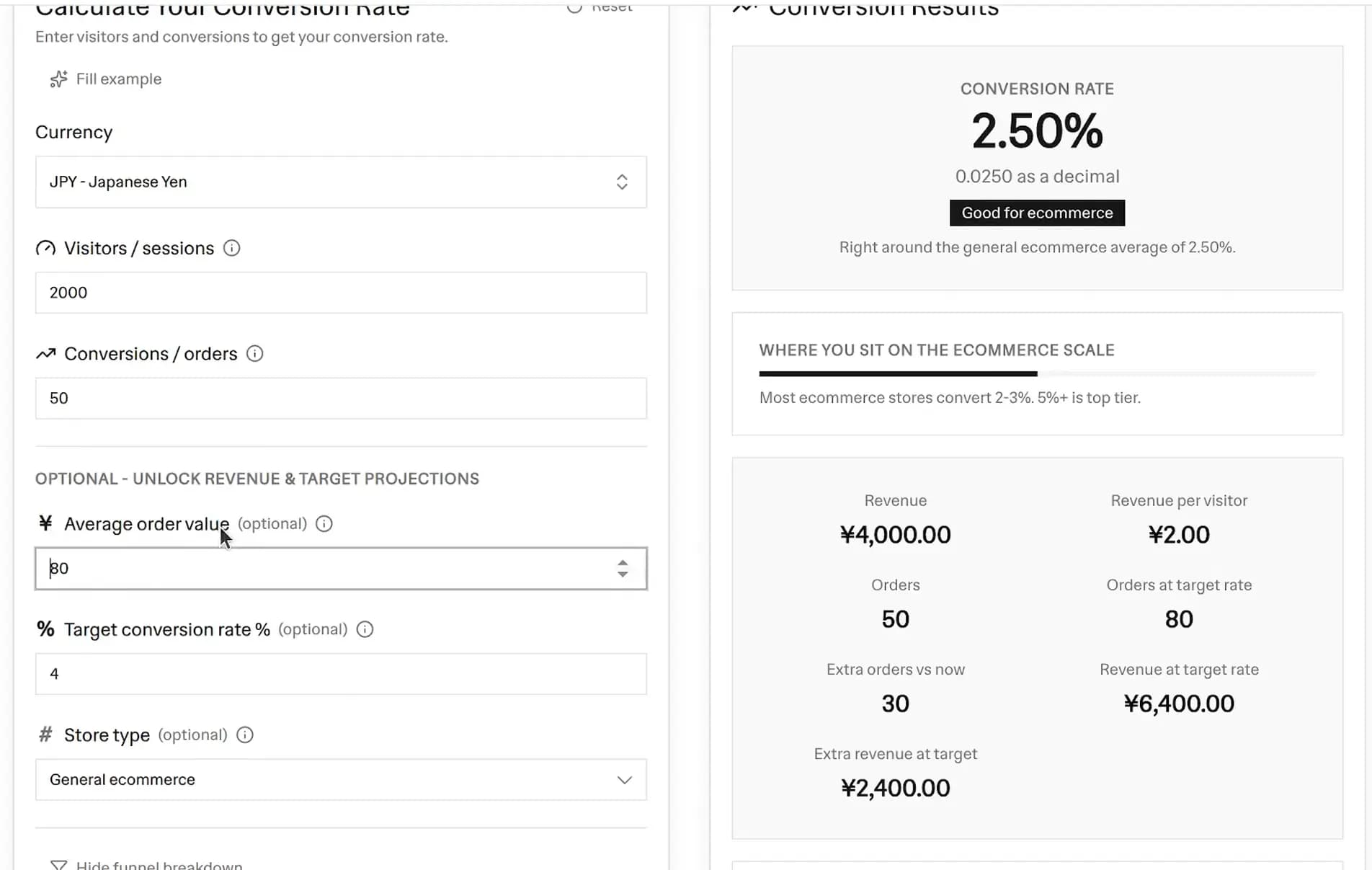 Ecommerce conversion rate calculator showing a 2.50% conversion rate from 2000 visitors and 50 orders, plus revenue, revenue per visitor, and the extra orders and revenue earned at a 4% target conversion rate
How to Calculate Conversion Rate by Hand
You do not need a tool to get the number. Here is how to calculate conversion rate in three steps:
- Count your conversions: This is your orders for the period.
- Count your visitors: This is your total sessions for the same period.
- Divide and multiply by 100: Divide conversions by visitors, then multiply by 100 to get a percent.
For example, 50 orders from 2,000 sessions is 50 / 2000 = 0.025, and 0.025 x 100 = 2.5%. The calculator above runs this for you and shows the decimal form too.
The Conversion Rate Formula
The conversion rate formula is short. This is the math behind every result on this page:
For ecommerce, conversions are orders and visitors are sessions. The same formula works for any goal, like email signups or add-to-carts, as long as you keep the numerator and denominator consistent.
In a spreadsheet, the formula is simple too. If orders are in cell A1 and visitors are in B1, your conversion rate is =A1/B1*100. This website conversion rate calculator saves you the spreadsheet step and adds revenue and benchmark context.
Worked Example
Say a DTC store had 2,000 sessions and 50 orders last month.
First find the conversion rate:
Now add an average order value of $80. Revenue is 50 x \$80 = \$4,000, and revenue per visitor is \$4,000 / 2,000 = \$2.00.
Set a target conversion rate of 4%. At that rate the store would get 2,000 x 0.04 = 80 orders. That is 30 extra orders, or 30 x \$80 = \$2,400 in extra revenue from the same traffic.
What Is a Good Ecommerce Conversion Rate?
There is no single answer, but there are useful benchmarks. Here is a simple scale for how to calculate ecommerce conversion rate performance:
- Below 1%: Weak. Usually a sign of poor traffic quality, a slow site, or a leaky checkout.
- 1% to 2.5%: Average. Most stores live here at some point.
- 2.5% to 5%: Good. You are converting better than the typical store.
- 5% and above: Top tier. Strong product-market fit and a smooth checkout.
Rates also vary by store type. Here is a rough by-vertical guide that matches the store-type selector in the tool:
| Store type | Typical conversion rate |
|---|---|
| General ecommerce | 2.5% |
| Apparel & fashion | 2.0% |
| Health & beauty | 3.0% |
| Electronics | 1.4% |
| Home & garden | 1.8% |
| Food & beverage | 3.7% |
| Gifts & collectibles | 2.4% |
These are illustrative averages, not hard targets. Real rates shift with your traffic source, price point, and season. Mobile usually converts lower than desktop, so a mobile-heavy store often sees a lower blended rate. Compare your store to its own trend first, and use the retail conversion rate calculator benchmarks as a sanity check, not a goal.
The Advanced Funnel Formula
Your conversion rate is really the product of every step a shopper takes. The funnel breakdown in the tool uses four stages: Visits to product page, Product page to add to cart, Add to cart to checkout, and Checkout to purchase. The full conversion rate is each stage multiplied together:
Say your four stages are 80%, 10%, 50%, and 75%. The math is 0.80 x 0.10 x 0.50 x 0.75 = 0.03, which is a 3% conversion rate. The lowest stage is the bottleneck. Here it is the 10% add-to-cart step. Fixing the weakest stage lifts the whole funnel the most, because every later step multiplies on top of it. The on-screen funnel card flags this leak for you.
Revenue Per Visitor and Why It Matters
Revenue per visitor (RPV) is one of the most useful numbers in ecommerce. The formula is simple:
RPV blends your conversion rate and your average order value into one figure. A store can lift RPV by converting more shoppers or by raising order value, so it rewards both levers at once. That makes it a better north-star than conversion rate alone, because a higher conversion rate at a lower order value can still mean less money per visit.
How a Small Conversion Lift Compounds
Small conversion gains are worth more than they look. The reason is that you earn the lift on every visitor, with no extra ad spend.
Take a store at 2% that lifts to 3% on the same traffic. That is a 50% increase in orders and revenue, even though the rate only moved one point. The target conversion rate field above projects exactly this. Enter your goal rate and it shows the extra orders and extra revenue from the lift. This is why conversion rate optimization often beats buying more traffic.
How to Improve Your Conversion Rate
Most conversion gains come from removing friction. Here is a short list of high-impact fixes:
- Speed up the site: Slow pages lose shoppers before they ever see the product.
- Simplify checkout: Cut steps, offer guest checkout, and reduce form fields.
- Add trust signals: Show reviews, ratings, and clear return policies.
- Use clear product photos: Multiple angles and zoom help shoppers decide.
- Remove surprise shipping costs: Show shipping early so the total at checkout is not a shock.
Test one change at a time so you know what moved the number.
Why Conversion Rate Matters for Shopify Sellers
Your conversion rate sits at the center of your store's economics. It decides how far each visitor goes, which in turn sets how much you can afford to pay for traffic.
Once you know your conversion rate, the rest of your numbers fall into place. Use the ROAS calculator to size your ad spend against the revenue your traffic returns. Use the break-even calculator to find the sales you need to cover costs. Use the profit margin calculator to price for profit. And if you run paid social, the Facebook ads calculator and Instagram ads calculator help you turn a conversion rate into a workable budget. A higher conversion rate makes every one of those numbers easier.
Frequently Asked Questions
What is a conversion rate?
The share of visitors who complete an action, usually an order. Conversion rate = conversions / visitors x 100. 50 orders from 2,000 visitors is a 2.5% rate.
How do I calculate conversion rate?
Divide conversions by total visitors, then multiply by 100. Example: 50 / 2,000 = 0.025 = 2.5%.
What is a good ecommerce conversion rate?
Most ecommerce stores convert about 2-3%. Above 2.5% is good and 5% or more is top tier. Below 1% usually signals a problem with traffic quality, pricing, or the checkout.
What is the conversion rate formula?
Conversion rate (%) = (conversions / visitors) x 100. For ecommerce, conversions are orders and visitors are sessions.
How do I increase my conversion rate?
Speed up the site, simplify checkout, add trust signals and reviews, use clear product photos, and remove surprise shipping costs. Small lifts compound: going from 2% to 3% is a 50% revenue increase from the same traffic.
What is revenue per visitor?
Revenue divided by visitors. It blends conversion rate and average order value into one number, so it is a good north-star metric for store growth.
Should I use sessions or users for visitors?
Be consistent. Most ecommerce teams use sessions because a shopper often visits more than once before buying. Pick one and stick with it.
Is this conversion rate calculator free?
Yes, 100% free, no signup, unlimited calculations.
More FREE Store Finance & Documents tools
Price products, forecast ad profit, bill customers, and create invoices, purchase orders, packing slips, and other order documents.
Free Expense Report Template Generator
Build a professional expense report. Add line items, mileage, and a cash advance, pick from 20 templates, and download a print-ready PDF, PNG, or CSV. Free, no signup, no watermark.
Free Timesheet Template Generator
Fill in a weekly, bi-weekly, or monthly timesheet template with live overtime and pay totals, pick from 12 templates, and download a print-ready PDF, PNG, or CSV. Free, no signup, no watermark.
Free Profit Margin Calculator
Calculate your product's selling price, gross margin, and net profit instantly. Factor in shipping and acquisition costs. Free, no signup.
Free Dropshipping Profit Calculator
Enter product cost, markup, ad spend per sale, and shipping to see your selling price, gross margin, and true net profit per dropshipping order. Free, no signup.
Free Print on Demand Profit Calculator
Enter provider base cost, markup, ad spend per sale, and shipping to see your selling price, gross margin, and true net profit per print on demand order. Free, no signup.
Free Markup Calculator
Turn cost and markup into your selling price, gross profit, and margin. Convert markup to margin, see your revenue multiplier, and price in bulk with CSV export. Free, no signup.
Free Etsy Fee Calculator
See every Etsy fee and your exact net payout, then switch to Stripe, Shopify, Square, Depop, Mercari, Poshmark, Reverb, or PayPal. Line-by-line breakdown, profit and margin, and a reverse net-to-price mode. Free, no signup.
Free Stripe Fee Calculator
See Stripe's processing fee and your exact net payout - 2.9% + $0.30 online, 2.7% + $0.05 in person. Line-by-line breakdown, profit and margin, and a reverse net-to-charge mode. Free, no signup.
Free Square Fee Calculator
See Square's processing fee by acceptance method - 2.6% + $0.15 in person, 2.9% + $0.30 online, 3.3% + $0.30 invoice, 3.5% + $0.15 keyed - and your exact net deposit. Profit, margin, and a reverse mode. Free, no signup.
Free Shopify Fee Calculator
See Shopify Payments processing by plan (Basic, Grow, Advanced), the transaction fee a third-party gateway adds, and your exact net payout. Profit, margin, and a reverse mode. Free, no signup.
Free Depop Fee Calculator
See what you keep on a Depop sale under the 2024 US structure - no seller selling fee, just 3.3% + $0.45 processing. Profit, margin, and a reverse net-to-price mode. Free, no signup.
Free Mercari Fee Calculator
See what a Mercari sale leaves you under the 2025 US structure - a flat 10% selling fee on item plus shipping, no seller processing fee. Profit, margin, and a reverse mode. Free, no signup.
Free Poshmark Fee Calculator
See your exact Poshmark earnings with the real US tiered fee - a flat $2.95 under $15, otherwise 20%. Profit, margin, and a reverse net-to-price mode. Free, no signup.
Free Reverb Fee Calculator
See what a Reverb sale leaves you: a 5% selling fee on item plus shipping (capped at $500) plus processing of 3.19% + $0.49 (2.99% + $0.49 Preferred). Profit, margin, and a reverse mode. Free, no signup.
Free Reverse Sales Tax Calculator
Back the sales tax out of any total. Find the price before tax and the tax amount from a gross total, with US state and Canada rate presets. Free, no signup.
Free ROAS Calculator
Calculate return on ad spend, break-even ROAS, and target ROAS, plus the ad budget needed to hit your revenue goal. Free, no signup.
Free Break-Even Calculator
Find the units and revenue you need to cover costs. Calculate your break-even point, contribution margin, and the sales needed to hit a profit goal. Free, no signup.
Free Customer Lifetime Value Calculator
Calculate customer lifetime value (CLV) two ways - historic and predictive - see net value after acquisition cost, and get a plain-English CLV:CAC health verdict. Built for Shopify and ecommerce. Free, no signup.
Free Customer Acquisition Cost Calculator
Calculate customer acquisition cost (CAC), compare blended vs paid CAC by channel, and get an LTV:CAC health verdict plus the CAC payback period. Built for Shopify and ecommerce. Free, no signup.
Free Shopify Profit Calculator
Calculate net profit and margin per order after COGS, shipping, ads, returns, and real Shopify plan and payment fees. See break-even CPA and ROAS, a profit waterfall, and the order volume where each Shopify plan becomes the cheapest. Free, no signup.
Free Invoice Generator
Create professional invoices with your logo, line items, tax, and discounts. Live preview and instant PDF download. Free, no signup.
Free Packing Slip Generator
Create a clean packing slip for any order. Add your logo, ship-to address, and items, then download a print-ready PDF. No prices, no signup.
Free Purchase Order Generator
Create a purchase order to send your supplier. Add the vendor, line items with agreed prices, and a delivery date, then download a PDF. Free, no signup.
Free Commercial Invoice Template
Create a customs-ready commercial invoice for international shipping. Add HS codes, country of origin, Incoterms 2020, weights and the declaration, then download a PDF. Free, no signup.
Free Proforma Invoice Template
Create a quote-style proforma invoice you can send before the sale is final. Add a valid-until date, itemised freight, and optional customs fields and Incoterms 2020, then download a PDF. Free, no signup.
Free Credit Memo Template
Create a print-ready credit memo that reduces what a customer owes on a prior invoice. Reference the original invoice, list the credited items, and the tool computes the credit total, then download a PDF. Free, no signup.
Free Bill of Lading Template
Create a print-ready straight bill of lading for domestic LTL freight. Add the shipper, consignee, carrier, freight lines with weight and NMFC class, and freight charge terms, then download a PDF. Free, no signup.
Free Work Order Template
Create a print-ready work order for a service call, preventive maintenance, HVAC, plumbing, construction or auto repair job. Add the service location, equipment, task checklist, labor and parts, then download a PDF with technician and customer sign-off. Free, no signup.
Free Order Form Generator
Create a professional order form template with line items and live totals. Add your logo, customer, and prices, then download a PDF. Free, no signup.
Free Quote Generator
Create a professional price quote with your logo, client details, line items, and a valid-until date. Live preview and instant PDF download. Free, no signup.
Free Estimate Generator
Create a professional job estimate with your logo, client details, line items, and an estimated total. Live preview and instant PDF download. Free, no signup.
Free Packing List Generator
Create an itemized packing list for ecommerce, wholesale, and freight shipments. Add shipper, consignee, and contents, then download a PDF. Free, no signup.
Free Delivery Note Generator
Create a delivery note with a signature line for proof of delivery. Add your details, the deliver-to address, and items, then download a PDF. Free, no signup.
Free Return Form Generator
Create a printable return form or RMA form for ecommerce returns. Add the return-from address, items, and reason, then download a PDF. Free, no signup.
Free Shipping Label Generator
Make a printable shipping label with From / To and package details. Pick a 4x6, half-sheet, or Avery template, add a barcode or QR, bulk-generate from CSV, and download PDF, PNG, or SVG. No email, no signup, no watermark.
Free Shopify Order Bill Splitter
Split a group Shopify order fairly. Import items from a product link, assign who shares what, split shipping, tax, and discounts, and see who pays whom with the fewest payments. Free, no signup.
Free Facebook Ads Calculator
Forecast your Facebook ad profits with real industry benchmarks, interactive sliders, and reverse budgeting. See ROAS, CPA, and net profit instantly. Free, no signup.
Free Instagram Ads Calculator
Forecast your Instagram ad costs and profits with real Instagram benchmarks, interactive sliders, and reverse budgeting. See ROAS, CPA, and net profit instantly. Free, no signup.